

Hiring a web design agency is a big deal. For most small businesses, it’s one of the biggest investments you’ll make in your marketing — and knowing the web agency red flags to watch for could save you thousands of pounds and months of wasted time. The web design industry has a real trust problem: there are plenty of agencies out there that overpromise, underdeliver, and leave you holding a website that does nothing for your business.
Knowing the most common web agency red flags before you sign anything is the best way to protect yourself. This guide walks you through seven warning signs to look out for — in plain English, no jargon — so you can make a smart, confident decision.
Whether you’re getting your first website built or redesigning an old one, keep this article bookmarked. It could save you a lot of headaches.
Why It’s So Hard to Tell a Good Agency From a Bad One
Let’s be honest — most bad agency experiences don’t happen because someone was careless. They happen because it’s genuinely hard to tell a good agency from a bad one just by looking at their website. They all use the same buzzwords. They all have shiny homepages and friendly sales calls.
But the gap between a great agency and a terrible one only becomes clear once the project starts — and by then, you’ve already signed the contract.
Here’s what a bad agency engagement can actually cost you:
- Money — wasted retainers, rebuild costs, paying twice for the same site
- Time — months of back-and-forth with nothing to show for it
- Momentum — lost leads, missed opportunities, a brand that looks unprofessional
- Trust — in agencies, in the process, and in your own ability to make marketing decisions
The good news? Most of these disasters are avoidable. You just need to know what to look for before you commit.
Red Flag #1: They Can’t Show You a Real Portfolio — or Their Own Website Is Poor
This one sounds obvious, but you’d be surprised how many people skip it. Any agency worth hiring should be able to show you a portfolio of real, live websites they’ve built — not mock-ups, not Figma screens, not “examples” that aren’t linked to actual businesses.
Ask to see real URLs. Click around. Check whether the sites load fast, look good on a phone, and actually make sense as websites for the businesses they represent. A beautiful-looking portfolio screenshot doesn’t mean much if the live site is slow, confusing, or impossible to navigate.
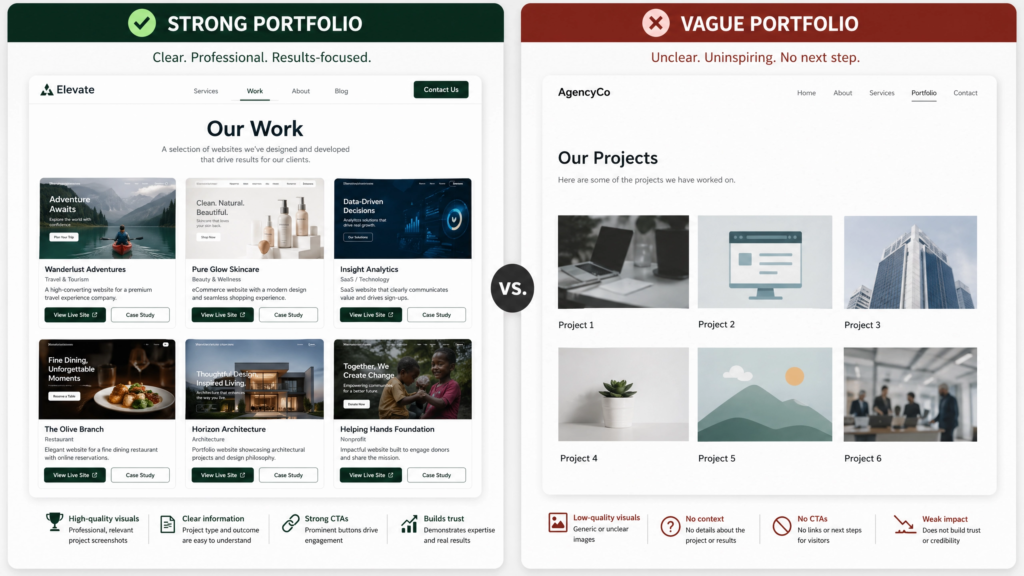
And here’s a bonus red flag: look at the agency’s own website. If it loads slowly, looks outdated, or makes it hard to find basic information like pricing and services, that tells you something. An agency that can’t build a good site for itself isn’t going to build one for you.
You can always check out the 36 Visuals portfolio to see what real project results actually look like.
Quick questions to ask: Can you send me links to three recent websites you’ve built? What were the business goals for each one? How did the design support those goals?
Red Flag #2: They Guarantee First-Page Google Rankings
If an agency promises you’ll be on page one of Google — especially by a specific date — walk away. This is one of the oldest tricks in the book, and it’s a lie every time.
Google itself is very clear that no one can guarantee a top ranking. Search rankings depend on hundreds of factors — your industry, your competitors, your content, your backlinks, your site’s technical health — and they change constantly. Any agency making this promise is either being dishonest with you or planning to use dodgy shortcuts that could actually get your site penalised.
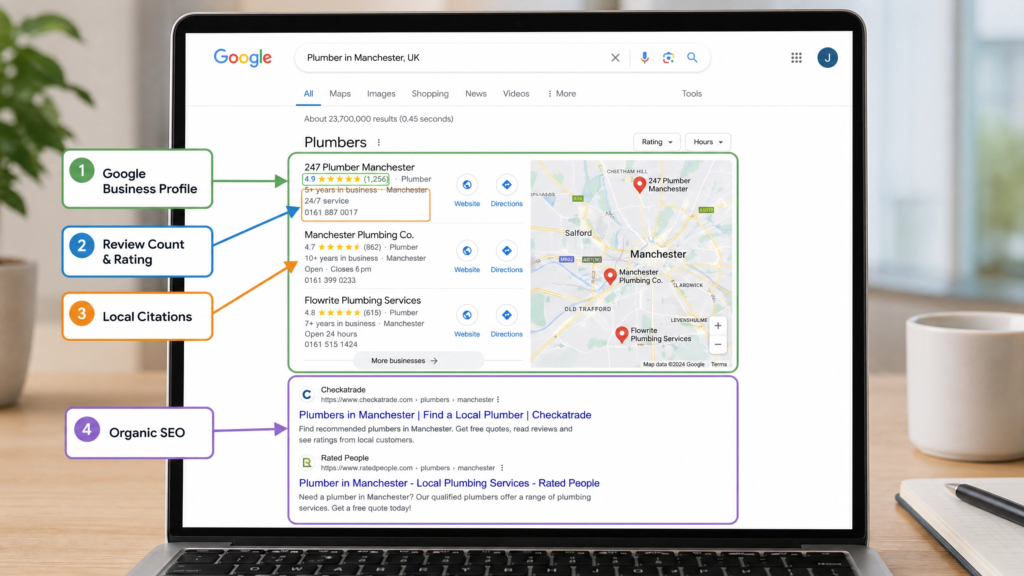
Now, a good web design agency should understand SEO and build your site with it in mind. That means clean code, fast loading times, proper heading structures, mobile responsiveness, and sensible page architecture. But there’s a difference between “we build sites that are SEO-ready” and “we guarantee you’ll rank number one.” The first is honest and helpful. The second is a web agency red flag.
If you’re just getting started with SEO, our free Beginner SEO Checklist is a great place to learn what actually moves the needle — without any fluff.
Web Agency Red Flags Around Process and Transparency
Red Flag #3: They’re Vague About Who Does the Work — and How
You had a great call with a senior designer who seemed to really get your brand. Brilliant. But who’s actually going to build your website?
One of the most common complaints about web agencies is what’s sometimes called the “bait and switch” — a senior person sells you the project, then hands it off to a junior team member (or even a freelancer overseas) with very little oversight. You don’t find out until you’re already three weeks into the project and things feel… off.
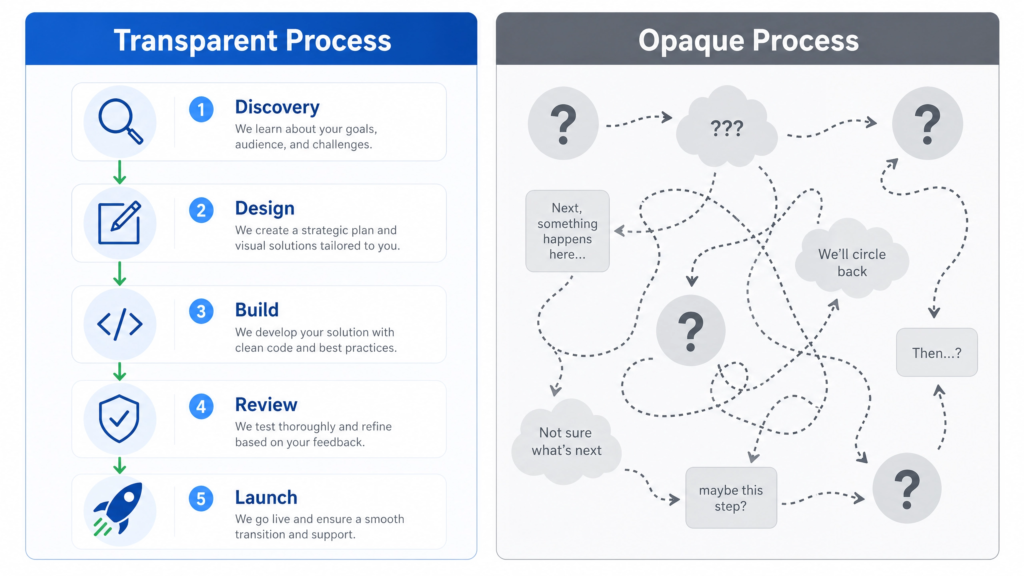
Before you sign anything, ask:
- Who will be my main point of contact throughout the project?
- Who will actually design and build the site? Can I meet them?
- What does your project timeline look like from start to launch?
- How do you handle feedback and revision rounds?
A good agency won’t hesitate to answer these. If they dodge the question or say “we’ll figure that out after you sign,” that’s a web agency red flag you shouldn’t ignore. You deserve to know exactly what you’re buying and who’s delivering it.
Red Flag #4: They Never Mention SEO, Speed, or Mobile
Design is visual, yes. But a website isn’t just art — it’s a tool. And if an agency spends your entire discovery call talking about colours, fonts, and how great it’s going to look without once mentioning how it’s going to perform, that’s a problem.
Here’s what a good agency should bring up without you having to ask:
- Mobile responsiveness — over 60% of UK web traffic now comes from phones. If your site looks bad on mobile, you’re losing customers before they’ve even read a word. Ofcom’s research consistently backs this up.
- Page speed — slow sites lose visitors fast. Google’s research shows that as page load time goes from one second to three seconds, the probability of a bounce increases by 32%.
- Basic on-page SEO — proper heading structure (H1, H2, H3), image alt text, meta descriptions, clean URLs. These should be standard practice, not extras you have to ask for.
- Core Web Vitals — Google’s set of performance signals that directly impact how your site ranks.
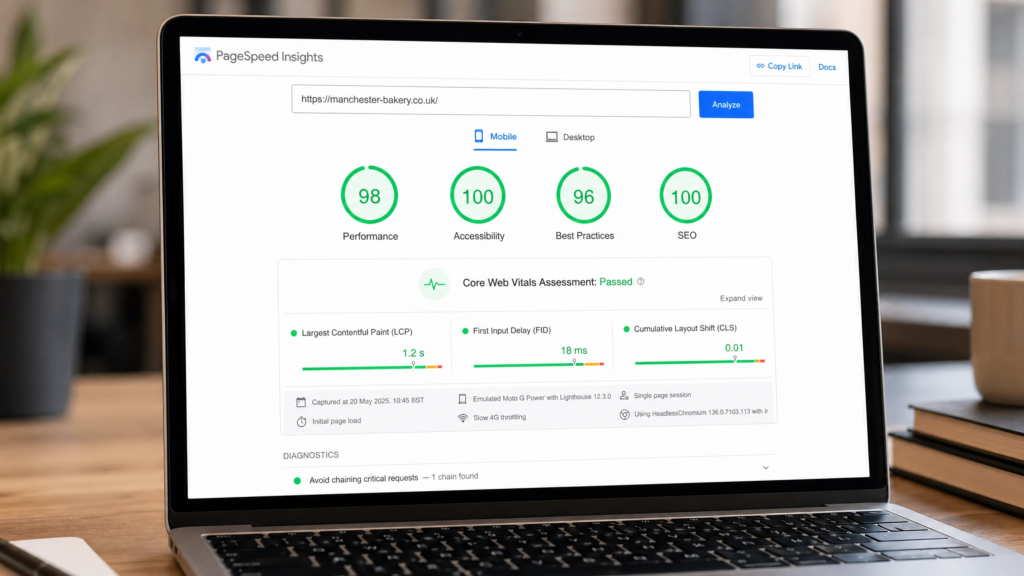
A beautiful website that loads slowly, breaks on mobile, and has no SEO foundation is just an expensive brochure that no one will ever find.
Red Flag #5: You Won’t Own Your Own Website
This one is sneaky. Some agencies build websites on proprietary platforms that only they can edit and maintain. Others technically “host” your site in a way that means if you ever want to leave, you have to start completely from scratch.
Here’s what full ownership of your website should look like:
- You own your domain name — it should be registered in your name, not the agency’s. If you need to set one up, 123 Reg is a solid, affordable option for UK businesses.
- You own the design files — if you want to take your project to another designer one day, you should be able to hand over the files.
- You can manage the content yourself — a good CMS (like WordPress) means you can update pages, add blog posts, and make basic changes without calling the developer every time.
- You can take your site elsewhere — if you ever want to move to a different agency or developer, the code and files should be fully portable.
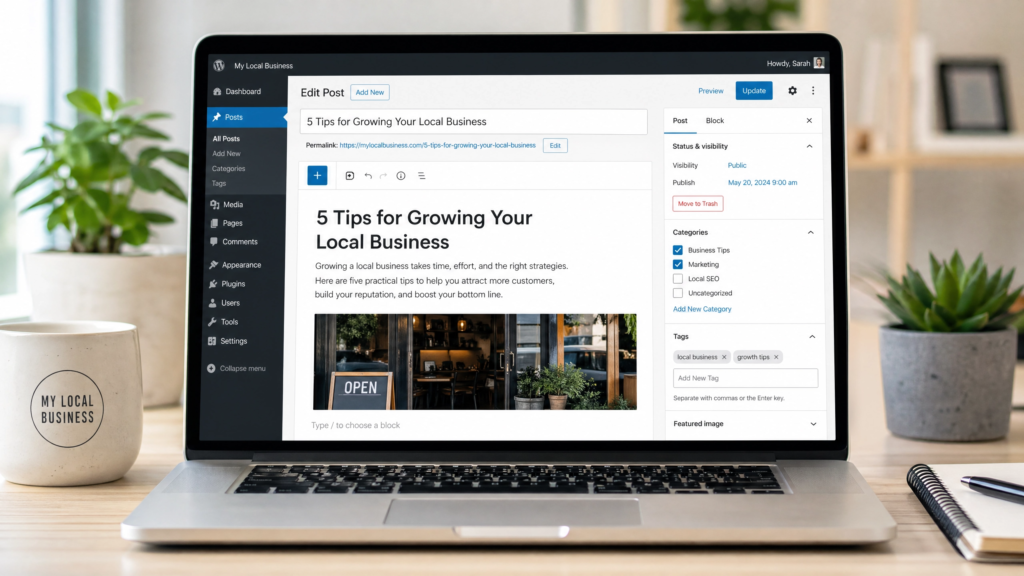
Ask these questions before you sign:
- Who owns the domain?
- What platform is the site built on?
- If I leave, can I take the site with me?
- Will you train me on how to use it?
If the answers are vague, or if the agency tries to position being on their platform as a benefit without acknowledging the lock-in, that’s one of the clearest web agency red flags you’ll encounter.
Web Agency Red Flag #6: They Lock You Into a Long Contract With No Clear Deliverables
Contracts are normal — and actually a good sign that an agency takes their work seriously. But there’s a huge difference between a fair contract and one that’s designed entirely to protect the agency’s revenue rather than your results.
Watch out for:
- 12-month retainers with no performance benchmarks — what happens if they’re not delivering? You’re still paying.
- Vague scope — a contract that says “website design and development” with no breakdown of pages, features, or revisions is a recipe for dispute.
- No exit clause — you should always have a way out if things aren’t working, without being penalised heavily for it.
- Unclear revision rounds — how many rounds of changes do you get? What counts as a revision? Get this in writing.
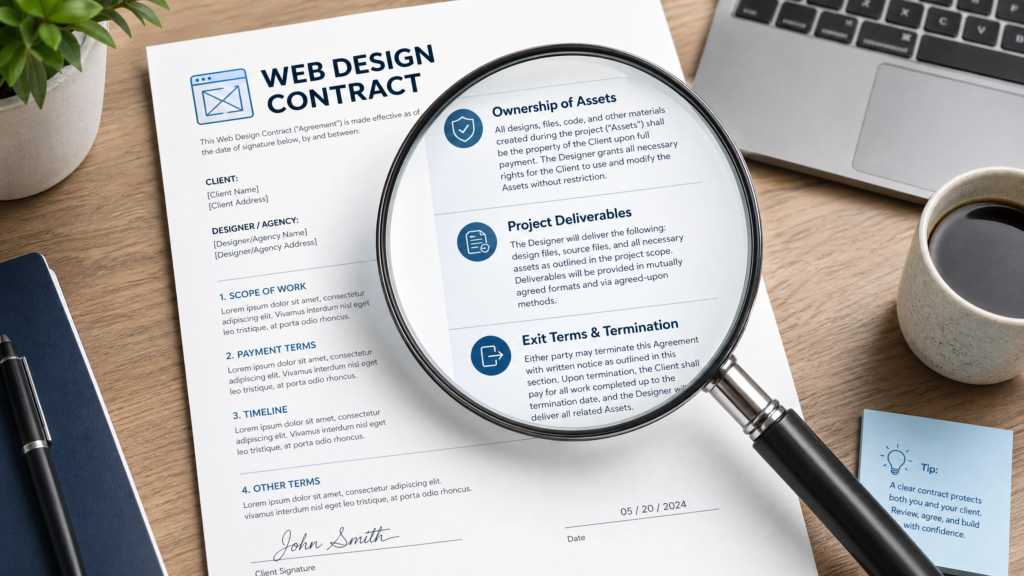
A legitimate agency will be happy to walk you through every section of their contract and explain what each clause means. If they get defensive or say “don’t worry, it’s standard,” that’s worth paying attention to. Fair terms protect both sides — any agency that resists clear deliverables or KPIs probably isn’t confident in what they’re going to deliver.
Web Agency Red Flag #7: They’re Pushy, Use Pressure Tactics, or Only Talk About Price
A good agency asks more questions than you do. They want to understand your business, your customers, your goals, and what success looks like for you before they talk about colour schemes or layouts. If the first thing out of an agency’s mouth is a price — or a discount that expires in 48 hours — that tells you where their head is at.
Here are some classic pressure tactics to look out for:
- “Your website is losing you money right now!” — used to create urgency and panic before you’ve even had a proper conversation
- “We have a slot opening up next week, but you need to decide today” — artificial scarcity
- “We’re offering 30% off if you sign this week” — if they can discount that heavily that fast, what does that say about their normal pricing?
- Talking about aesthetics before understanding your business — if they’re describing what your site will look like before they’ve asked who your customers are, they’re designing for themselves, not for you

You should never feel pressured into a decision this big. The right agency will give you time to think, encourage you to ask questions, and be completely transparent about pricing and process. If the chemistry feels off during the sales call, trust your gut — it’ll probably be worse once the project starts.
Not sure if your current website is actually working for your business? A free Website Audit can show you exactly what’s holding it back — no strings attached.
How to Spot a Good Agency Instead
Now you know the web agency red flags to avoid, here’s a quick checklist of what to look for instead:
✅ A real, live portfolio with examples relevant to your industry
✅ Transparent process — you know who does what and when
✅ SEO and performance built in from the start
✅ You own your domain, files, and CMS
✅ Clear contract with defined deliverables, revision rounds, and an exit clause
✅ They ask questions about your business before they talk design
✅ Honest, pressure-free communication from day one
It’s also worth thinking about whether you need more than just a website. A strong brand identity — your logo, colours, fonts, and overall visual style — is what makes your website feel cohesive and professional. If you’re not sure where your brand stands right now, try the Brand Quiz — it takes a few minutes and gives you a clear picture of what your brand is communicating (and what it might be getting wrong).
Final Thoughts on Web Agency Red Flags
Spotting web agency red flags before you sign is one of the smartest things you can do as a business owner. You don’t need to be a tech expert or a marketing guru — you just need to know the right questions to ask and the warning signs to watch for.
To recap, here are the 7 red flags to avoid:
- No real portfolio — or their own site is poor
- Guaranteed Google rankings
- Vague about process and who does the work
- No mention of SEO, speed, or mobile
- You won’t own your website
- Long contracts with no clear deliverables
- Pressure tactics and pushy sales behaviour
If an agency ticks even two or three of these boxes, trust your instincts and keep looking. The right one is out there — and when you find them, building your website will feel less like a risk and more like an exciting step forward for your business.
Want to see what a transparent, no-pressure process actually looks like? Have a browse through the 36 Visuals portfolio or get in touch — we’re always happy to chat, no obligation.